This is an old revision of the document!
Table of Contents
Contamination, Excluded Areas and Sampling
MLA/2025/00263
PD Ports marine licence application MLA/2025/00263 supplied only 31 samples for both the Port of Hartlepool and the River Tees as specified by the sampling plan supplied by the MMO on the recommendation of Cefas.
| Dredge Parameter | Value |
|---|---|
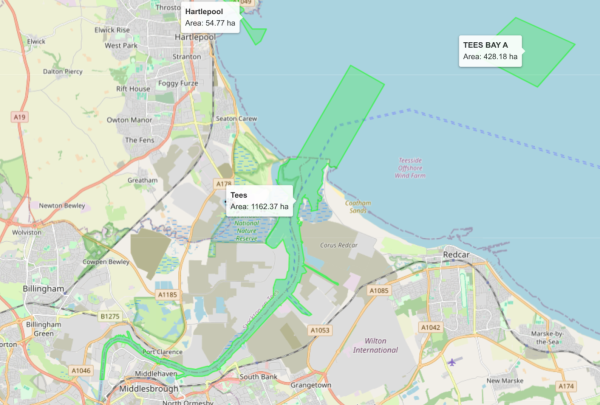
| Total dredged area of the River Tees | 1162.37Ha |
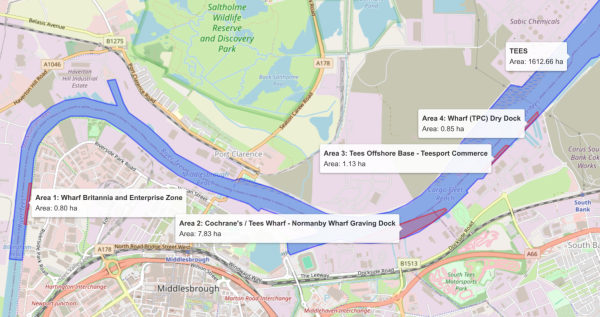
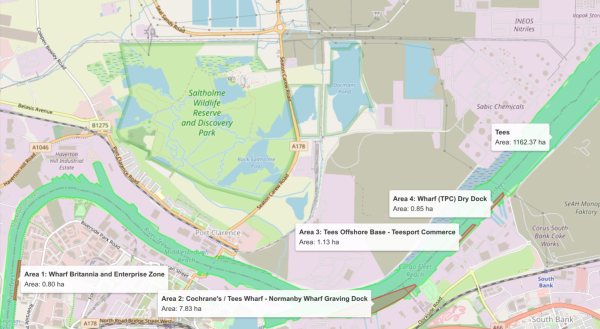
| Total excluded area from dredging | 10.61Ha |
| % of total dredged area excluded | 0.91% |
| Area of smallest excluded area | 0.8Ha |
| % of total dredged area made up by smallest excluded area | 0.07% |
| Number of times smallest excluded area fits into total dredge area | 1453 |
The licence was granted with just 27(31 if 4 are included for Hartlepool) samples taken over the whole 1162.37Ha area, meaning that there was only 1 sample for every 43.05Ha or 1 sample for every 62 football pitches.
| # | Name | Area Ha | % Total Dredge Area | # Fit Into Total Dredge Area | # Fit Into Single Sample Area |
|---|---|---|---|---|---|
| 1 | Britannia Wharf and Enterprise Zone | 0.80 | 0.07 | 1452.96 | 53.81 |
| 2 | Cochranes Tees Wharf - Normanby Wharf Graving Dock | 7.83 | 0.67 | 148.45 | 5.50 |
| 3 | Tees Offshore Base - Tees Commerce | 1.13 | 0.10 | 1028.65 | 38.10 |
| 4 | Wharf(TPC) Dry Dock | 0.85 | 0.07 | 1367.49 | 50.65 |
| All | Total Area | 10.61 | 0.91 | 109.55 | 4.06 |
The table above just drives home that 27 samples would have been drastically insufficient to be able to detect the current excluded areas and as such will not be able to detect similar currently unknown highly toxic areas within the total dredge area.
The number of times an area fits into the total dredge area is dramatic, for the smallest excluded area of 0.8Ha it fits 1452 times. While this sounds like a lot of samples in fact to be sure of finding such small areas then the best approach would be adopt a grid and divide the dredge area into 50m squares and taking a sample in the middle each square. This would give a greater than 95% chance of detecting all the 0.8Ha, but would require over 4,600 samples.
4,600 samples is the maximum number for the river and in fact by using knowledge of the river the number of samples necessary can be reduced considerably but not to 27.
The Cefas justification for 31 samples for the Tees and Hartlepool rather than working from a high number instead considers historical precedent, economic costs and the OSPAR volume table alone. Where the OSPAR volume table rather sets a minimum number of samples which should be taken for anything other than a deep capital dredge when read in context and so this number is inappropriate for a large area maintenance dredge.
The OSPAR guidance states that both spatial and volumetric representation must be achieved. To this end, the OSPAR guidance provides two tables, the volumetric table which uses the amount to be dredged to recommend 31 samples for a uniform volume of dredged material (i.e. a deep capital dredge), whereas the area table recommends 581 samples to provide spatial representation appropriate for a large area port maintenance dredge.
MLA/2015/00088
| Dredge Parameter | Value |
|---|---|
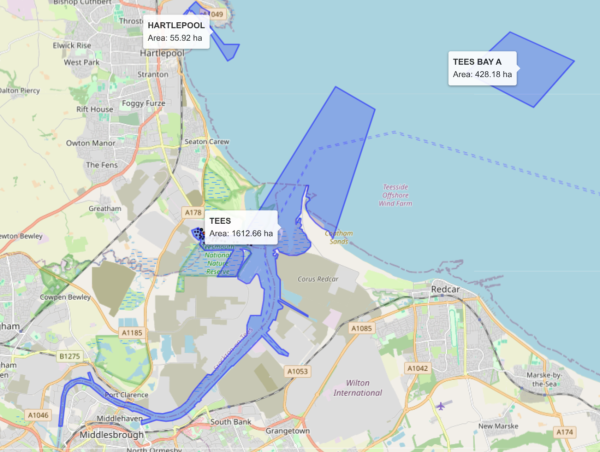
| Total dredged area of the River Tees | 1612.66Ha |
| Total excluded area from dredging | 10.61Ha |
| % of total dredged area excluded | |
| Area of smallest excluded area | 0.8Ha |
| % of total dredged area made up by smallest excluded area | |
| Number of times smallest excluded area fits into total dredge area | |