
Table of Contents
Dredged material from Rotterdam: where do you put it?
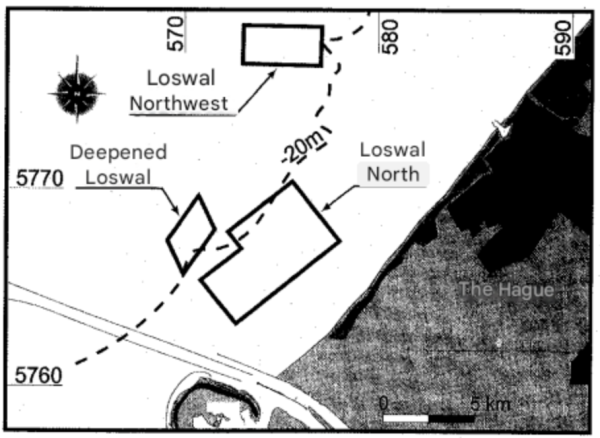
Rotterdam has the largest port in the world. This port forms an artificial sluice in the coastal zone and continuously silts up under the influence of weather and tides. Maintaining such a port requires extensive dredging. Therefore, large ships dredge the harbor and the shipping channel around the clock to maintain their accessibility. Ships dump most of the dredged harbor sediment at sea. The contaminated sediment is stored in the depot “De Slufter.” The dumping is not done randomly, but within two fixed, demarcated embankments (Figure 1), each a few kilometers in diameter, called unloading embankments.
From 1960 onwards, dumping took place at the North Wharf. This old wharf became full, and it was also suspected that dredged material might be flowing back into the harbor. Therefore, two new wharves were put into use: the North West Wharf (1996) and the Deepened Wharf (2000). Before a new wharf can be put into use, legal requirements must first be met. For example, an environmental impact assessment must be prepared.
After the new quays are put into use, the actual impact on the environment and mass flows must be investigated. Below is a report on the research, with remarkable results.
An unnatural hole
In the past, the Rhine and the Meuse simply flowed into the North Sea. The suspended solid particles in the water were washed away just go with it. Now, there's a harbor at the end of the river, and this “unnatural dip” causes the water to flow more slowly. As a result, a lot of floating material sinks to the bottom. This floating material, called dredged material when dredged, comes from two directions: from the river and from the sea with the tidal current. The amount of dredged material varies annually and depends, among other things, on river discharge and weather conditions (storms). However, on average, it amounts to 5 million tons of dry matter per year. All quantities are expressed on a dry matter basis and not as a wet volume because the amount of water in dredged material (in the harbor bottom, in the ship's well, and on the North Sea floor) varies. To give an idea of the amount of dredged material, let's imagine that all dredged material is transported in trucks would be crammed in. This would require a line of trucks spanning half the equator each year.
Figure 1: The location of the three quays on the North Sea
The law: Environmental impact assessment
Due to years of dumping dredged material, the sea at Loswal Noord was only 10 meters deep in some places. Furthermore, model calculations showed that one-third of the dumped dredged material flowed back into the harbor and shipping channel. Therefore, new locations for unloading wharves were sought. An Environmental Impact Assessment (EIA) investigated suitable new unloading wharves. These had to be both economically beneficial (lower dredging costs) and environmentally friendly for marine life. The Rotterdam Municipal Port Authority and the South Holland Directorate of Rijkswaterstaat (RWS) took the initiative to prepare this EIA. The North Sea Directorate (RWS) is the authority that ultimately must grant permission for the new unloading wharves to be put into use. These three authorities commissioned the National Institute for Coastal and Marine Research (RWS) to conduct a study into the effects of the new unloading wharves. This study answered many of the questions posed in the EIA. A very short management summary has been prepared for the quick reader. For the specialists there are two thick detailed reports on Loswal Noord and Loswal Noordwest and on the Verdiepen Loswal.“
How much dredged material flows back? The key question from a financial perspective is, of course: “How much dredged material flows back from the quay to the harbor and shipping channel?” Answering this short question took a lot of time, and a definitive answer is impossible. However, substantiated estimates have been made. We used a total of five methods to answer this question, but not every method is suitable for every quay.
The first and oldest method is the theoretical approach. A calculation model was used to simulate reality as closely as possible. However, the old calculation model from 1991 yielded different results than the improved model from 1999. The calculation model distinguished four mass flows:
- the total mass of dredged material, i.e. sand plus sludge (W1) and the sludge mass (W2) that flowed away from the unloading quay. Furthermore, the total mass of dredged material (R1) and the amount of sludge (R2) that flowed back to the harbor from the unloading quay. Table 1 shows the results of the model calculations.
- Secondly, we examined whether less dredging occurred after Loswal Noordwest came into operation. Dredging efforts decreased by approximately 40%. However, this cannot be considered a direct consequence of the transition to a different disposal site. The period is too short for that. The annual dredging volume varies considerably, depending on weather conditions (storms and river discharge).
- Third, the amount of silt in the dredged material and the amount ultimately remaining on the quay were measured. The hopper and the harbor bottom contained 38 to 55% silt, and the Northwest Quay contained 18% silt. Assuming that silt but not sand flows away from the quay, it can be calculated that 25 to 46% of the total amount of dredged material discharged flows away from the quay.
- Fourth, we followed an accounting approach: (i) first determine how much dredged material was dumped on the unloading quay, (ii) then measure the volume of the dumping pile on the unloading quay, (iii) and finally, determine the dry density of the dredged material on the unloading quay. From (ii) and (iii), the amount of dredged material remaining on the dumping pile is determined. Calculations show that 50% of the dumped dredged material has disappeared from the Northwest Unloading Quay and 51% from the Deepened Unloading Quay. Figure 2 shows the results from the Northwest Unloading Quay. 78% and 70% of the sludge, respectively, have flowed away.
- Finally, the fifth method examined the amount of sediment lying on the seabed south of Loswal Noordwest due to the dumping. If it can be assumed that the amount of sediment on the seabed is directly proportional to the amount that flowed southward to the port via the seawater, then it follows that 17% of the dumped dredged material flows back to the port and shipping channel. Of the sediment, 27% has flowed back.
Effect on the environment
Four years after the dumping was stopped, the soil life on Loswal Noord has largely
Recovered, but not yet completely. The small organisms, the benthic worms, in particular, have made a good comeback. The dumping of thick layers of dredged material on Loswal Noordwest has decimated benthic life in a relatively small part of the Dutch coastal zone between Voorne and IJmuiden.
The impact is noticeable up to 1 to 3 kilometers from the discharge quays, particularly in the direction of the tidal currents. Toxicological tests on Discharge Quay North, where disposal took place for 30 years, show that the dredged material is not toxic. The decline in benthic life must therefore be attributed entirely to burial.
Chemical contamination on the bottom of the quays is limited. Levels of tributyltin (5x), cadmium (3x), mercury (3x), and organic micropollutants (3x) are higher than in the undisturbed seabed. Levels of other heavy metals are not elevated. The levels of metals and organic micropollutants in the dredged material on the seabed meet the 'Uniform Content Test'.
Rigorously different?
To date, dredged material has been dumped on quays. This method differs significantly from the “natural” flow of solid marine and fluvial material in the pre-harbor era. Because benthic life only deteriorates through burial, the question arises whether it wouldn't be better to spread dredged material over a very large area. Spreading it over, say, ten or twenty square kilometers is an approach more similar to the old situation. Preliminary calculations indicate that this would result in an annual layer of one and a half centimeters on the seabed.
Benthic organisms are accustomed to such disturbance. Moreover, half of that layer disappears over time. If dispersal over a large area is combined with tidal-dependent dumping (sailing far at low tide and staying close to home at high tide), dredging might also be cheaper because the sailing distance would decrease.
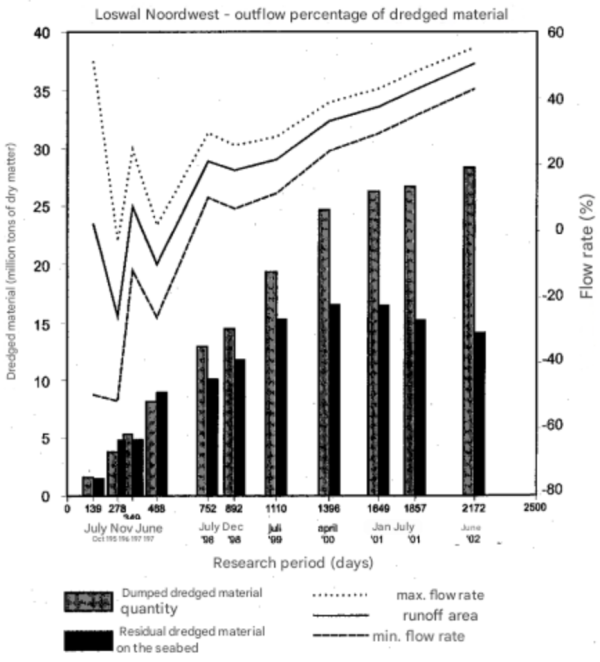
Fig. 2 Loswal Noordwest, dredged material outflow percentage
Table 1
The results of the outflow percentages (what percentage flows away from the unloading quay) and return percentages (what percentage flows back to the port) from Unloading Quay North, Northwest and the Deepened Unloading Quay according to model calculation for dredged material and for the silt fraction (<63 µm) from dredged material.
| Model Calculation | Outflow rate | Return rate | ||
|---|---|---|---|---|
| W1 | W2 | R1 | R2 | |
| Loswal Noord Model 1991(MER) - Average conditions Model 1999 | 50% | 80% | 32% | 44% |
| - Average conditions Loswal Northwast Model 1991 (MER) | 44+/-22% | |||
| - Average conditions model - 1999 | 29% | 68% | 0% | 0% |
| - Average conditions | 24 - 48% | 42 - 84% | 16+/-6% | 22+/-11% |
| - Average conditions + storm | 13+/-6.5% | 22+/-11% | ||
| Deepened discharge Wharf Model 1991 (MER) - Average conditions | 8% | 20% | 3% | 7% |
Sandeh Stutterheim, AKWA/RIKZ
Info:
tel.: (070) 311 43 42
email: sandeh@rikz.rws.minvenw.nl
*) Request DONAR files by email to: basisinfodesk@rikz.rws.minvenw.nl.
The Sandwich Construction: a stronger base
Nationally, there is a strong focus on limiting the volume of dredged material that must be disposed of in a depot. Sandy material is separated, while other, less sandy material is matured into soil. This reduces the volume of dredged material that needs to be disposed of. If a useful application can be found for the resulting sand and matured clay, the circle will be complete. Whether reusing dredged material is truly a solution for optimal use of depot space depends on the sales of the resulting products. A demonstration project was recently launched near the Slufter depot on the Maasvlakte. This project aims to boost the sales of products made from dredged material.
Near the Slufter, construction continued throughout April on a layered embankment of sand and matured clay from dredged material (both Category I material). The project is a joint initiative of the Rotterdam Municipal Port Authority (RMA) and the Directorate-General for Public Works and Water Management (RWS) of South Holland. Together, they manage the Slufter. These managers are and will continue to explore processing options with a high environmental return (large-scale and financially attractive).
The unique aspect of this project is that, in addition to research into the 'Sandwich' phenomenon, much has been achieved in the area of controlling and guiding the clay maturation process.
Even now, before the results of the field measurements are known, the consultants involved from the Road and Hydraulic Engineering Department (AKWA/DWW) and Fugro, also based on test projects,
Projects on the A5 and 50 roads present no obstacles to the use of matured clay in structural embankments. It appears that a client can impose civil engineering requirements on the product to be used. The processor can control the maturation process somewhat by regularly turning it. This way, a minimum required consistency can be achieved within a year, expressed as a consistency index of 0.6. [The consistency index -Ic- is a measure of water content. The value provides, among other things, an indication of the strength immediately after application of the clay. An Ic of 0.8 is normally required for clay processing.]
Clay: an ancient material
Admittedly, the use of matured clay in constructions is not new. For centuries, clay from the (water)bed has been used, either after maturation or not, in dikes or under
Roads. Consider the old Lekdijk dike near Bergambacht. This dike is also constructed of clay and proved almost indestructible during strength tests by Rijkswaterstaat.
Because sand has been the primary building material in recent decades, we've “forgotten” that clay is a common building material. Given its properties, specific considerations must be taken into account when using it. For example, compacting clay layers requires different equipment than sand, and construction takes longer.
The construction
To achieve a stable, low-consistency clay structure, a layered construction was chosen for the sandwich structure, consisting of two 1.5-meter layers of clay. Between these layers is a 0.5-meter layer of sand. Low-consistency clay is somewhat resilient. Interspersing the clay with a layer of sand increases the structure's rigidity. Moreover, the sand can serve as a drainage layer for any excess water. All of this allows the embankment to be constructed and built upon more quickly.
The contractor's employees were briefed prior to construction. They were informed about the purpose of the demonstration project, the materials used, and the proposed working method.